
Non-preferential origin
Non-preferential rules of origin are applicable in the trade with countries with which the RM has no free trade agreements.
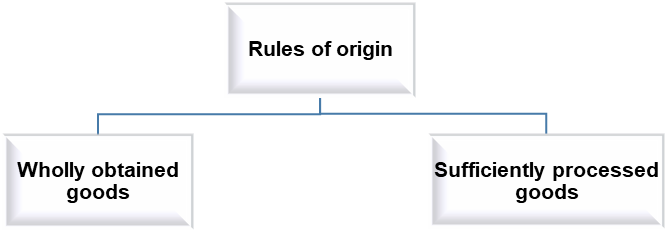
Two rules are applied in order to determine the origin:
Goods wholly obtained in the country – plants and vegetable products grown or harvested in a single country; mineral products extracted from the soil; vegetable products harvested in the country; live animals born and raised in the country and products obtained from live animals;
To be treated as wholly obtained in a given country, goods must not include any components of foreign origin.
Sufficiently processed goods – applied if raw materials from several countries were used for manufacturing of goods. This rule comprises three criteria:
- rule of change of tariff (sub) heading in the Harmonized System – a change in the Combined Nomenclature of Goods at the level of any of the first four digits, resulting from processing the goods;
- value added rule – a change in the value of goods if the share of the cost of materials used to produce the goods is at least 45 per cent;
- list of processing operations – a list of manufacturing or processing operations that are sufficient to confer on the goods the origin of the country in which these operations were carried out.
There are several operations considered as insufficient processing and that cannot confer the final product the status of originating product. Such operations include the following operations and processes performed individually or in combination:
- preserving operations to ensure that the products remain in good condition during transport and storage;
- breaking-up and assembly of packages;
- washing, cleaning; removal of dust, oxide, oil, paint or other coverings;
- ironing or pressing of textiles;
- simple painting and polishing operations;
- husking, partial or total bleaching, polishing, and glazing of cereals and rice;
- operations to colour sugar or form sugar lumps;
- peeling, stoning and shelling, of fruits, nuts and vegetables;
- sharpening, simple grinding or simple cutting;
- sifting, screening, sorting, classifying, grading, matching (including the making-up of sets of articles);
- simple placing in bottles, cans, flasks, bags, cases, boxes, fixing on cards or boards and all other simple packaging operations;
- affixing or printing marks, labels, logos and other like distinguishing signs on products or their packaging;
- simple mixing of products, whether or not of different kinds;
- simple assembly of parts of articles to constitute a complete article or disassembly of products into parts;
- a combination of two or more operations specified in paragraphs (a) to (n);
- slaughter of animals.